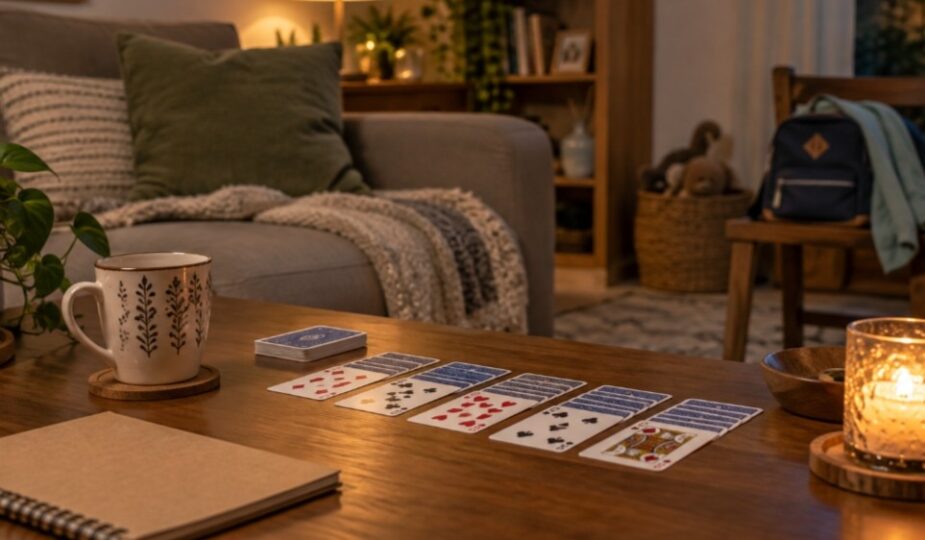
A Quiet Card-Game Break for Parents After the Evening Rush
The busiest part of family life often arrives just before the house becomes quiet. Dinner needs clearing, bags need checking, tomorrow’s clothes need finding and one final request appears just as the lights go out. When those tasks are finished, a parent may have a short stretch of time but very little appetite for another complicated decision.
A small, familiar activity can mark the change from family logistics to personal time. That might be a warm drink, a chapter of a book or one deal of classic solitaire. The point is not to make the evening more productive. It is to choose something with a clear beginning and end.
Finish the essential handover first
A quiet break feels less restful when half-finished tasks are still asking for attention. Before sitting down, deal with the few items that genuinely affect the morning: set the alarm, put the necessary form in the bag and check any time-sensitive message.
Do not try to complete every possible household job. Write the rest down. A short list keeps a non-urgent task from circulating in your head, while also making clear that it has not been forgotten.
If another adult is sharing the evening, say that you are taking ten minutes. A clear handover is kinder than disappearing behind a screen while the other person assumes you are still available for every small job.
Choose something easy to stop
Some forms of entertainment are built around the next episode, post or level. They can be enjoyable, but they are not always a good fit for a narrow window before bed. A self-contained card deal has a more visible edge.
Set the rule before beginning. It might be one deal or ten minutes. Do not change it to “until I win” after a difficult start. A timer helps when you need to prepare for sleep or return to another responsibility.
A browser game is convenient because it can open without a long setup. Keep the sound off if the house is settling, and lower the brightness rather than staring at a harsh screen in a dark room.
Let familiar rules carry the activity
After a day filled with choices, learning a new system can feel like another demand. Klondike solitaire uses a structure many people already recognise. Tableau cards descend in alternating colours, and the foundations build each suit upward from ace.
The decisions remain interesting without requiring a tutorial. Should a card move to the foundation now, or is it still useful in the tableau? Is an empty column available for a king? Can a face-down card be uncovered before returning to the stock?
These are contained questions. They belong to the board and end with the session. That makes the game different from opening an inbox, where every item can produce another task for tomorrow.
Protect the break from household admin
It is tempting to combine a break with ordering groceries, replying to school messages or checking the bank. Those tasks may be necessary, but they turn the pause into a second work period.
If something urgent comes to mind, add it to the list and return to the chosen activity. If it can wait until morning, let it wait. If it cannot, end the break deliberately, complete the task and begin a new pause later rather than pretending both things happened at once.
Notifications can create the same problem. Use a short focus setting or place the phone in do-not-disturb mode while keeping important family contacts allowed. The aim is not to become unreachable. It is to prevent routine alerts from choosing how the next ten minutes will be spent.
Notice whether the screen is helping
A quiet game can provide a useful change of pace, but a screen is not always the answer. If your eyes are tired, choose music, stretching or a paper book. If you have been sitting, walk around the house or step outside for a moment.
The activity should match the need. A card game can suit a parent who wants a small, orderly task after an untidy day. It may be less helpful when the body needs movement or when a conversation still needs to happen.
There is no need to turn this choice into a rigid routine. Use it when it fits and choose something else when it does not.
Stop without scoring the evening
A lost deal is not a failed break. Winning is one possible ending, but the value of the pause came from its boundary. You stepped away from the list of family tasks, focused on one contained activity and returned when you intended.
Avoid using win rate or speed as a measure of whether the time was worthwhile. That can turn a quiet pastime into another performance target. If the board becomes frustrating, close it and choose a different activity.
Parents rarely control every part of an evening. A child may wake, a message may require attention or tomorrow’s plan may change. A useful break works around that reality. It starts quickly, stops cleanly and does not create another obligation.
The evening rush may never become completely calm. A small pause can still create a line between what had to be done for everyone else and a few minutes chosen for yourself.